Part 1
Intuition & the Crisis of Understanding
“his slow speech had overtones not of thought, but of understanding beyond thought.”
John Steinbeck, Of Mice and Men
Physical intuition is currently undervalued in physics and nowhere is this more evident than the Copenhagen “interpretation” of quantum mechanics. The sociological factors that have led to a lack of appreciation for the fundamental role played by physical pictures is the focus of part 2 of this book, but to motivate our discussion of physical intuition in part 1, let’s begin by taking thematically from part 2. On page 149 of the 1971 sociology journal, The Social Production of Scientific Knowledge, Richard Whitley writes in his article Changes in the Social and Intellectual Organisation of the Sciences:
“The elevation of highly abstract, logically closed conceptual systems to definitive status as science results in attention being focussed on purely formal properties of concepts and relations and the exclusion of all those which are not susceptible to treatment by the current most ‘elegant’ and ‘simple’ formalism… It also directs attention away from substantive problems towards esoteric manipulations which may or may not have any physical meaning… this view implies there is a hierarchy of prestige and authority resting on abstraction and formality.”
Richard Whitley, “Changes in the Social and Intellectual Organisation of the Sciences,” in The Social Production of Scientific Knowledge (1971), p. 149
Whitley’s explanation is remarkably clear. He has identified that scientific authority is often associated with abstract formulas, in the same way a priest’s authority is derived from the “mastery” of sacred rituals. Just as the ark of the covenant was to remain behind a cloth curtain, shielded from the eyes of the common worshipper, or as the Catholic mass is given in Latin, and not the listener’s native tongue, so too are undergraduates instructed in the logic of abstract vector spaces of quantum mechanics. As an undergraduate I asked the professor who was teaching my quantum information class what his opinion on the underlying physical reality of quantum mechanics was. He said, “I’m from the school of ‘Shut up and calculate,’” which translates to “Don’t think about what the equations represent physically, just do the algebra and tell me what number you get at the end.” A friend in that same class said this about the material: “if we’re not allowed to ask what the equations physically represent, then we’re just doing mathematical theology.” The supposed vanguard of truth in our time, the theoretical physicists, have indeed become a religion. To the naive person, as I once was and still sometimes am, this state of affairs is remarkable, even bizarre. It is in fact the most normal thing in the world, but to see this we must step outside the normative structure of our society into a more scientific view of the situation. This is the goal of part 2 of this report, in which the general psychological and sociological mechanisms behind this priesthood of physicists is explored in as much detail and clarity as possible.
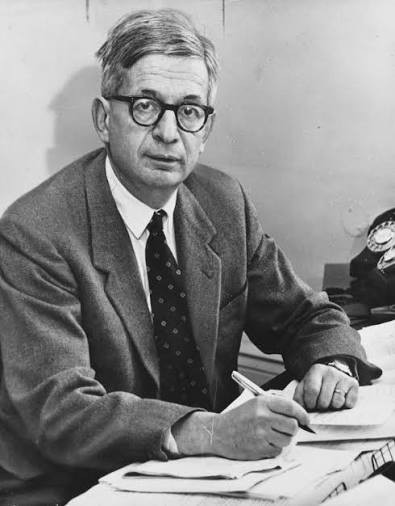
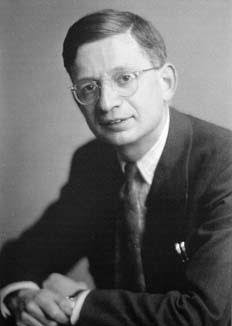
Direct physical understanding, being the natural predator of all religious dogma, is threatened with temporary extinction in the current academic climate. We can understand this threat directly by analyzing the purest manifestation of this religion of mathematical abstraction: the Copenhagen Interpretation. For this purpose I call to the stand Rudolf Peierls, whose 1979 book Surprises in Theoretical Physics was recently recommended to me by a physicist at MIT, which is to say he is considered a legitimate source in the physics community. This is what he has to say about the nature of quantum waves:
“When do we contract the wave function? Not until we have become aware through our visual, or other sensory observation, that one or the other of the two alternative possibilities is realized… This situation sounds extremely unsatisfactory if one tries to take the view that the wave function, or in the more general case the state function, should be a physical object, like an observable. But this is a mistaken view… What is then the significance of the state function occurring in this equation; whose knowledge does it represent, and when do we decide to contract it? This question seems to pose an insurmountable difficulty. But it is based on the assumption that living beings, such as our observer, can be described by the existing laws of physics.”
Rudolf Peierls, Surprises in Theoretical Physics (1979), pp. 32–33
Peierls resolves the “extremely unsatisfactory” logical structure of the Copenhagen Interpretation by giving up “the assumption that living beings, such as our observer, can be described by the existing laws of physics.” A special role for humans in the structure of reality, free from the shackles of entropy and gravity. Perhaps in an earlier age Peierls would have found it easy to believe in humans walking on water and rising from the dead; his beliefs about quantum mechanics come to the same thing in the end. In a 1957 letter to Hugh Everett, the physicist and philosopher Philipp Frank perfectly captured the absurdity of this position, writing:
“I have always disliked the traditional treatment of ‘measurement’ in Quantum Theory according to which it seems as if ‘measurement’ would be a type of fact which is essentially different from all other physical facts.”
Philipp Frank, Letter to Hugh Everett (1957)
The flawed logic of this perspective is explored in more detail in part 3 of this report, but I introduce it here to explain why a discussion of physical intuition deserves to be part 1 of this book.
Today we are dealing in physics with a crisis of understanding at the most fundamental level, but then again this is always the case in theoretical physics. If there weren’t great contradictions in our theories there would be no darkness left for us to explore. The fact that it is normal for physics to experience revolution does not remove the work ahead. We are faced with a crisis. Students have been trained, by means of implicit incentives, not to think in terms of physical pictures, but rather to memorize abstract formalisms by rote, as though they were handed down from God. This was also a problem in earlier ages, but it is in some ways worse today, due to the increasingly bureaucratized nature of the scientific process.
Further, the tenets of the Copenhagen philosophy, which mandate a special, magical role for human beings in the laws of physics, require that one suspend physical reasoning for the simple reason that its tenets are absurd, and physically contradictory. This has created a culture in which physical reasoning is not only not incentivized, but is actually persecuted. It is well known in the physics community that inquiring into the foundations of quantum mechanics is considered “unpragmatic” and “philosophical” and is likely to seriously limit one’s career if one takes such inquiries seriously. But it is just this line of questioning that a foundational thinker must consider if they are to produce revolutionary work at the deepest level. By labeling the most fundamental physical questions “off limits,” the culture of the discipline has cut itself off from its life source: physical understanding. Pablo Echenique Robba, Argentine-born Spanish physicist and politician, says this of the censorship of foundational inquiry:
“When all persuasion strategies have failed, the only thing that remains to be tried is to suggest that your career, your assets, your mental well-being, your ‘success’ in general will be jeopardized if you are fool enough to break the rules and do the forbidden thing. This last-resort (and somewhat desperate) move is in the air all the time, but it is also explicitly used in the otherwise great book by Streater (2007)… Now, what we need is clever people that are not afraid of thinking deep, of getting their hands dirty, and of tackling great problems. If you feel like giving it a try and you meet some headwind howling that ‘everything is understood,’ that ‘understanding is not our job,’ or that it is ‘impossible’ or ‘too difficult,’ if some colleagues tell you that ‘physics does not deal with whys,’ that ‘understanding is just being Newtonian’ or that ‘Thou shall not philosophize,’ if they throw invented norms to you, or if weaknesses and career prospects enter the discussion when the debate gets all heated up… you can always answer ‘Shut up and let me think!’ — and get back to work.”
Pablo Robba, Shut Up and Let Me Think! Or Why You Should Work on the Foundations of Quantum Mechanics as Much as You Please, pp. 27, 29
This section is part of my response to censorship of physical understanding. The physics community’s view of understanding is evidenced in its educational apparatus, which prioritizes the ability to reproduce known results, deriving calculations by applying established formulas, over the ability to divine new relationships. This is misguided. In this section we explore the process of physical understanding not merely as rote memorization but as a vitality which integrates apparently separate facts into cohesive pictures.
Part 2 · Section 1.1
Taking Your Time
“In science, it is not speed that is the most important. It is the dedication, the commitment, the interest and the will to know something and to understand it — these are the things that come first.”
Eugene Wigner, in an interview by István Kardos (1978), Scientists Face to Face, Corvina Kiadó, p. 370
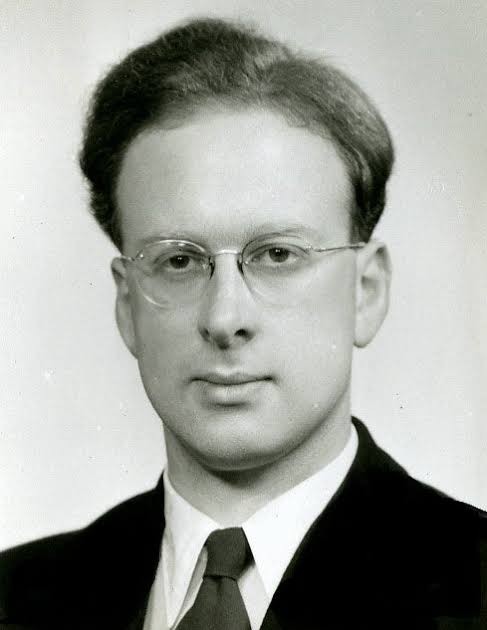
Why talk about taking your time? It is an important mode of thinking to emphasize because it is presently underappreciated. We will save the sociological discussion of why it’s undervalued for part 2. For now I hope physics Nobel prize winner Peter Higgs’s words will be enough to motivate our discussion:
“It’s difficult to imagine how I would ever have enough peace and quiet in the present sort of climate to do what I did in 1964… Today I wouldn’t get an academic job. It’s as simple as that. I don’t think I would be regarded as productive enough.”
Peter Higgs, in an interview with Decca Aitkenhead, The Guardian, December 6, 2013
If you pour water from a hose onto hard, dry ground, at first most of it runs off without penetrating, and in places fine dry dust even repels the liquid into little beads that roll away. Yet if you come back later, once the dry flat ground has softened with the moisture it absorbed, it takes in water much more readily. There is an analogy to the creative process here, in which certain ideas take time to develop. Returning to a subject after a first pass is like “wetting the topsoil of the mind,” so that the concepts are absorbed more deeply the second time around. Deep understanding cannot be rushed; it requires a relaxed space in which the subconscious can set to work developing the ideas poured into it by the conscious mind, the same way molecules of water percolate through a dry medium.
Let’s move from the subject of learning in general to talk about active problem solving. Arthur uses a very cool analogy about a medieval siege to explain the value of patience in solving difficult problems:
“Everyone has a research style,” says Arthur. “If you think of a research problem as being like a medieval walled city, then a lot of people will attack it head on, like a battering ram. They will storm the gates and try to smash through the defenses with their intellectual power and brilliance. Their approach was strength. My approach was strength. I like to take my time; as I think,” he says. “So, I just camp outside the city and wait. And I wait. Until one day people inside [the defenders] say, ‘We surrender.’ The answer to the problem comes all at once.”
W. Brian Arthur, in Complexity: The Emerging Science at the Edge of Order and Chaos, p. 29
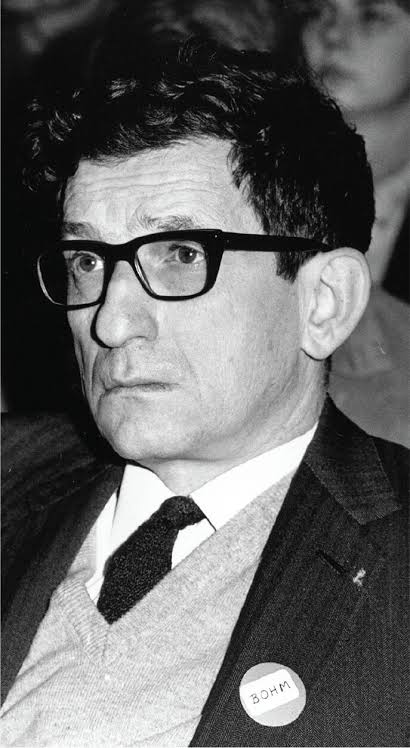
David Bohm, of Aharonov–Bohm effect fame, expresses a working style that is similar to Arthur’s:
“My way of working (which I am finding effective in science) is to try to avoid exhausting yourself by headlong attacks on insurmountable rock walls. Instead, I like the method of ceaselessly feeling out various aspects of the problem, seeing how things fit together, looking for cracks and weak points. When you find a crack, explore all the surrounding region, and if it looks as if there is a possibility there, you hit that crack with all you’ve got. Sometimes you are gratified by seeing a split in a problem that previously seemed impenetrable. But sometimes this means delaying decisive action for a long time. I have found it very profitable to delay an ‘all out’ attack on the plasma problem for about a year and a half, while I slowly absorbed various aspects, got various ideas, some right and some wrong.”
David Bohm, quoted in F. David Peat, Infinite Potential: The Life and Times of David Bohm
Let’s look at excerpts of Arthur and Bohm’s quotes side by side to draw attention to their similarity. Arthur wrote: “a lot of people will attack it head on, like a battering ram… I just camp outside the city and wait. And I wait. Until one day people inside [the defenders] say, ‘We surrender.’” In the same vein Bohm says: “My way of working (which I am finding effective in science) is to try to avoid exhausting yourself by headlong attacks on insurmountable rock walls… sometimes this means delaying decisive action for a long time… Sometimes you are gratified by seeing a split in a problem that previously seemed impenetrable.”
Arthur uses the idea of a castle wall, Bohm of a rock wall, and both emphasize the importance of waiting until the problem “solves itself” by revealing a previously hidden weakness. Einstein expresses his support for this way of problem solving:
“The formulation of a problem is often more essential than its solution, which may be merely a matter of mathematical or experimental skill. To raise new questions, new possibilities, to regard old problems from a new angle, requires creative imagination and marks real advance in science.”
Albert Einstein & Leopold Infeld, The Evolution of Physics: The Growth of Ideas from Early Concepts to Relativity and Quanta (New York: Simon and Schuster, 1938), p. 92
What this means is that it is not raw IQ that solves the really tough problems, but some deeper, more holistic property of the brain that internally correlates patterns of reality in new, previously unassociated ways. This is the brain’s primary evolved purpose — to mirror external reality within its own structure so that it can predict what will happen next. But the growth of these internal structures is organic, and it takes time. This is evidenced in Einstein’s creative process. He took his time in “The formulation of a problem.” Eugene Wigner explains:
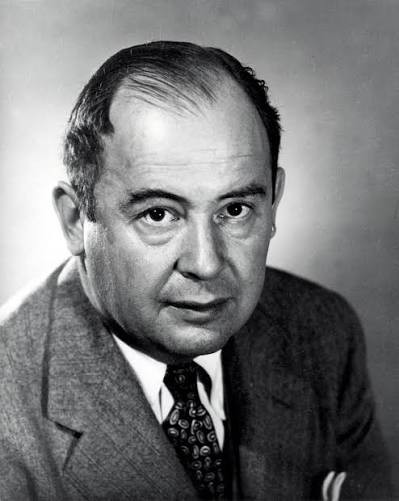
“I have known a great many intelligent people in my life. I knew Max Planck, Max von Laue, and Werner Heisenberg. Paul Dirac was my brother-in-law; Leo Szilard and Edward Teller have been among my closest friends; and Albert Einstein was a good friend, too. And I have known many of the brightest younger scientists. But none of them had a mind as quick and acute as Jancsi von Neumann. I have often remarked this in the presence of those men, and no one ever disputed me. […] But Einstein’s understanding was deeper than even Jancsi von Neumann’s. His mind was both more penetrating and more original than von Neumann’s. And that is a very remarkable statement. Einstein took an extraordinary pleasure in invention. Two of his greatest inventions are the Special and General Theories of Relativity; and for all of Jancsi’s brilliance, he never produced anything so original.”
Eugene Paul Wigner, The Recollections of Eugene P. Wigner: As Told to Andrew Szanton
von Neumann was clearly a smart person who made valuable contributions to science. His way of working, i.e., analytically/algebraically, can be understood as a deductive approach. It is linear and methodical. Induction, on the other hand, is more global, taking more time to develop. In the inductive approach one must wait for relationships between entire categories to reorganize themselves until the useful “formulation of the problem” becomes evident. In the following section we will explore the relationship between induction and deduction to discover that a dynamic balance of both techniques is necessary for progress in physics.
Part 3 · Section 1.2
Induction and Deduction
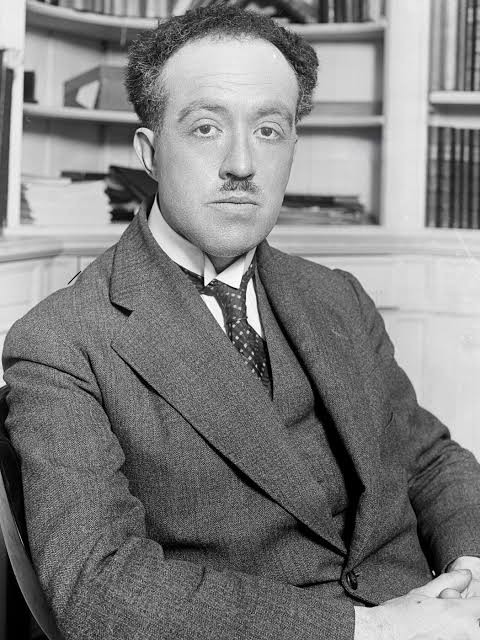
“Based as it is on analogy and intuition and on subtle distinctions rather than geometric precision, induction attempts to divine unknown relations, and thus to establish new principles from which deductions may then be made. Clearly, inductive reasoning is much bolder and much more adventurous than deductive reasoning. Deduction is certainty, at least in appearance; induction is risk. But risk is the price paid for all great achievements, and that is why induction, because it disdains established truths to venture forth into unexplored fields, may be said to be the true source of all great scientific advances… Naturally this does not mean that the rigor of deductive reasoning has no merit. It is thanks to deduction that our imagination is prevented from getting out of hand and that the consequences of inductive discoveries can be checked against the facts. Deduction endows scientific theories with their indispensable precision and provides an invaluable antidote against flights of fancy. But shackled as it always has been by its own rigor, deduction alone can never hope to be more than just that. Hence the reader will understand why the axiomatic method, although most satisfying intellectually, is least fruitful in practice… Although rigorous axiomatic theories cannot be called useless, they do not generally make any great contributions to important scientific advances simply because they ignore intuition, which alone can reveal previously unknown facts.”
Louis de Broglie, New Perspectives in Physics, pp. 203, 205
Why talk about induction and deduction? It is important because, like taking your time, induction is presently undervalued in physics culture. As we saw in 1.1, taking your time is necessary for induction, and so it is natural that in a culture which emphasizes speed of results, deduction would emerge as the favored strategy. Our current approach leaves little room for induction, which is, as de Broglie has said, “the true source of all great scientific advances,” or as Einstein put it earlier, “To raise new questions, new possibilities, to regard old problems from a new angle, requires creative imagination and marks real advance in science.”
But induction can only function if it is paired with the scaffolding of deduction! The meaning of this section is not to emphasize one as better than the other, but rather to demonstrate that only a harmony between the two approaches will lead to another revolution in our understanding of physics. Neither induction nor deduction alone will suffice in isolation. Useful as the skills tested on physics exams may be, there are other skills the test does not know about, skills that are often orthogonal to the ones being tested. The skill being tested in physics courses is deduction, and induction is its orthogonal counterpart. De Broglie correctly identifies induction and deduction as complementary forces that interfere to create a stable process. Deduction is indeed indispensable, for it is only by an absolute fealty to the principle of logical consistency that we remain tethered to reality. Even so, rigorous logic is not capable of telling which axioms we should start with, and here intuition becomes indispensable.
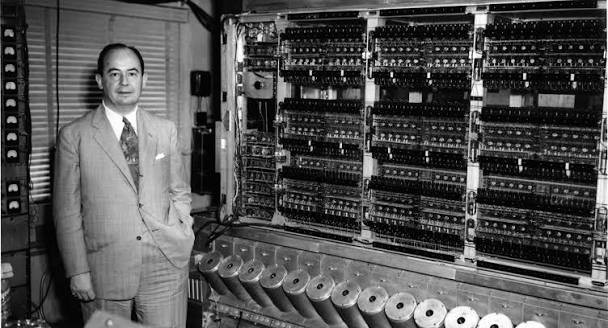
In a 1951 talk titled “Some basic theorems on the foundations of mathematics and their implications,” delivered to the American Mathematical Society, Gödel explains the meaning of his incompleteness proofs: “There is no escaping the necessity of assuming some axioms or rules of inference as evident without proof, because the proofs must have some starting point.” Gödel is saying that intuition/induction is necessary for selecting among sets of axioms. In other words, deduction within a system of rules is applied downstream of an intuitive choice of which rules to use in the first place. John von Neumann explains:
“The first formulations of the calculus were not even mathematically rigorous. An inexact, semi-physical formulation was the only one available for over a hundred and fifty years after Newton! And yet, some of the most important advances of analysis took place during this period, against this inexact, mathematically inadequate background! Some of the leading mathematical spirits of the period were clearly not rigorous, like Euler; but others, in the main, were, like Gauss or Jacobi. The development was as confused and ambiguous as can be, and its relation to empiricism was certainly not according to our present (or Euclid’s) ideas of abstraction and rigour. Yet no mathematician would want to exclude it from the fold — that period produced mathematics as first class as ever existed! And even after the reign of rigour was essentially re-established with Cauchy, a very peculiar relapse into semi-physical methods took place with Riemann. Riemann’s scientific personality itself is a most illuminating example of the double nature of mathematics, as is the controversy of Riemann and Weierstrass, but it would take me too far into technical matters if I went into specific details. Since Weierstrass, analysis seems to have become completely abstract, rigorous, and unempirical. But even this is not unqualifiedly true. The controversy about the ‘foundations’ of mathematics and logics, which took place during the last two generations, dispelled many illusions on this score.
This brings me to the third example which is relevant for the diagnosis. This example, however, deals with the relationship of mathematics with philosophy or epistemology rather than with the natural sciences. It illustrates in a very striking fashion that the very concept of ‘absolute’ mathematical rigour is not immutable. The variability of the concept of rigour shows that something else besides mathematical abstraction must enter into the makeup of mathematics. In analyzing the controversy about the ‘foundations,’ I have not been able to convince myself that the verdict must be in favour of the empirical nature of this extra component. The case in favour of such an interpretation is quite strong, at least in some phases of the discussion. But I do not consider it absolutely cogent. Two things, however, are clear. First, that something non-mathematical, somehow connected with the empirical sciences or with philosophy or both, does enter essentially — and its non-empirical character could only be maintained if one assumed that philosophy (or more specifically epistemology) can exist independently of experience. (And this assumption is only necessary but not in itself sufficient). Second, that the empirical origin of mathematics is strongly supported by instances like our two earlier examples (geometry and calculus), irrespective of what the best interpretation of the controversy about the ‘foundations’ may be.”
John von Neumann, “The Mathematician,” in The Works of the Mind, ed. Robert B. Heywood, vol. 1, no. 1 (Chicago: University of Chicago Press, 1947), pp. 180–196
As von Neumann has said, “something else besides mathematical abstraction must enter into the makeup of mathematics.” Pauli explains that the “non-mathematical” entity that enters into rigorous physics/math is intuition/induction:
“In contrast to the purely empirical conception according to which natural laws can, with virtual certainty, be derived from the material of experience alone, many physicists have recently emphasized anew the fact that intuition and the direction of attention play a considerable role in the development of the concepts and ideas.”
Wolfgang Pauli, The Influence of Archetypal Ideas on the Scientific Theories of Kepler (1955)
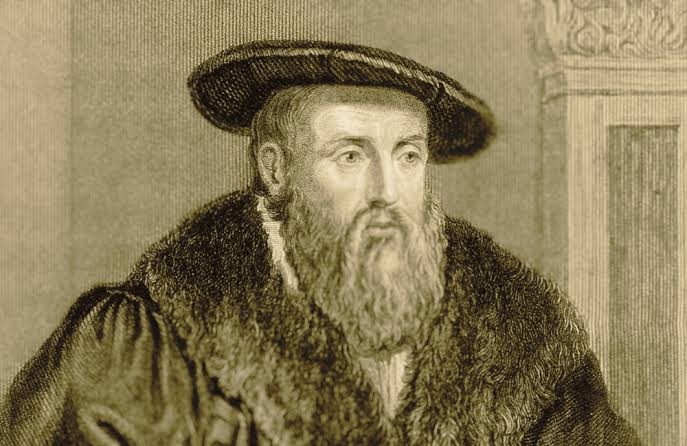
From the citation we can infer that Pauli is talking about Kepler, and we see Pauli’s perspective reflected in Kepler’s own words. Kepler’s language is somewhat archaic, but it is worth reading because his insight into the creative process is accurate:
“That faculty which perceives and recognizes the noble proportions in what is given to the senses, and in other things situated outside itself, must be ascribed to the soul. It lies very close to the faculty which supplies formal schemata to the senses, or deeper still, and thus adjacent to the purely vital power of the soul, which does not think discursively, i.e., in conclusions, as the philosophers do, and employs no considered method, and is thus not peculiar only to man, but also dwells in wild animals and the dear beasts of the field…”
Johannes Kepler, Harmonice Mundi (The Harmony of the World), Book IV (1619)
Kepler’s comment about “animals and the dear beasts of the field…” reminds me of a dog I once knew who, for all his great qualities, was a rather poor mathematician. Despite this absence of ability he managed to understand certain aspects of the world quite well. For instance, when we would go on walks to the park he would keep up a good pace, dragging me along so that I had to pull back on the leash with effort. But on the way home from the park it was the opposite! I had to drag him along. You see, he preferred the park, and he had worked out which velocity vector of ours correlated to which outcome. He understood causality, despite not knowing any math! This is just as true of humans as it is of dogs. Of course math is one way we can understand causality/physics, but it is not the only, or even the most fundamental way that we grasp it.
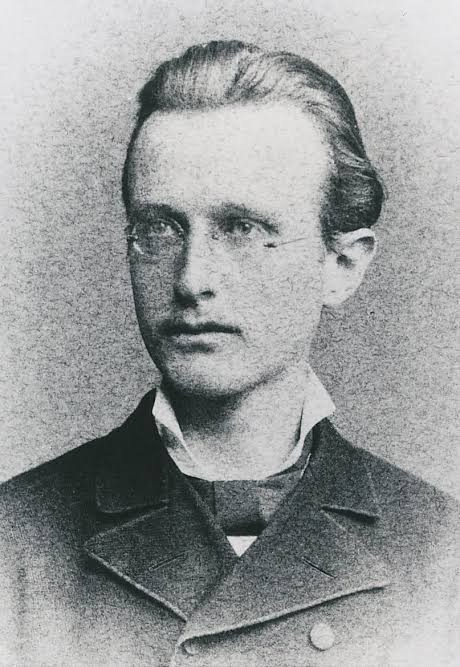
The following words from Max Planck resonate with the preceding ones from Kepler. For instance, Kepler’s “employs no considered method” is synonymous with Planck’s statement that “there can be no general rule.” Now to Planck:
“We see then that a good working hypothesis is essential for inductive investigation. This being so, we are faced with the difficult question of how we are to set about to find the most suitable hypothesis. For this there can be no general rule. Logical thought by itself does not suffice — not even where it has an exceptionally large and manifold body of experience to aid it. The only possible method consists in immediately gripping the problem or in seizing upon some happy idea. Such an intellectual leap can be executed only by a lively and independent imagination and by a strong creative power, guided by an exact knowledge of the given facts so that it follows the right path.
Such an intellectual process generally consists in the introduction of certain mental images and analogies, which point the way to the reigning laws already known in other regions, thus suggesting a further step towards the simplification of the physical view of the world.
It is precisely at these points where success seems to be awaiting us, however, that a serious danger is frequently hidden. Once a step forward has succeeded and the working hypothesis has demonstrated its usefulness, we must go further. We have to reach the actual essence of the hypothesis and, by suitably formulating it, we have to throw light upon its genuine content by eliminating everything that is inessential. This process is not as simple as it might appear. The intellectual leap of which we spoke above constructs a kind of bridge by which we can approach fresh knowledge; but on closer examination, it frequently appears that this bridge is merely provisional, and that a more enduring structure must be put in its place, capable of bearing the heavy artillery of critical logic.
We must bear in mind that every hypothesis is the outcome of the efforts of imagination, and that imagination works through direct intuition. But in Physics, as soon as we come to look for a rational theory or a logical demonstration, direct intuition is a very doubtful ally, however indispensable it may be while we are forming our hypothesis. For while it is natural that we should rely upon imaginations and ideas of this kind, which proved fruitful in one direction or another, such reliance is only too apt to lead to an overestimation of their importance and to untenable generalizations.
We must further recognize that the authors of a new and practicable theory are frequently little inclined to introduce any important changes in the groups of ideas which led them towards their discoveries, whether from indolence or from a certain sentimental feeling, and that they often exert the whole of their well-earned authority in order to be able to maintain their original standpoint. Thus we shall readily understand the difficulties which often stand in the way of healthy theoretical development.”
Max Planck, The Universe in Light of Modern Physics, pp. 35–36
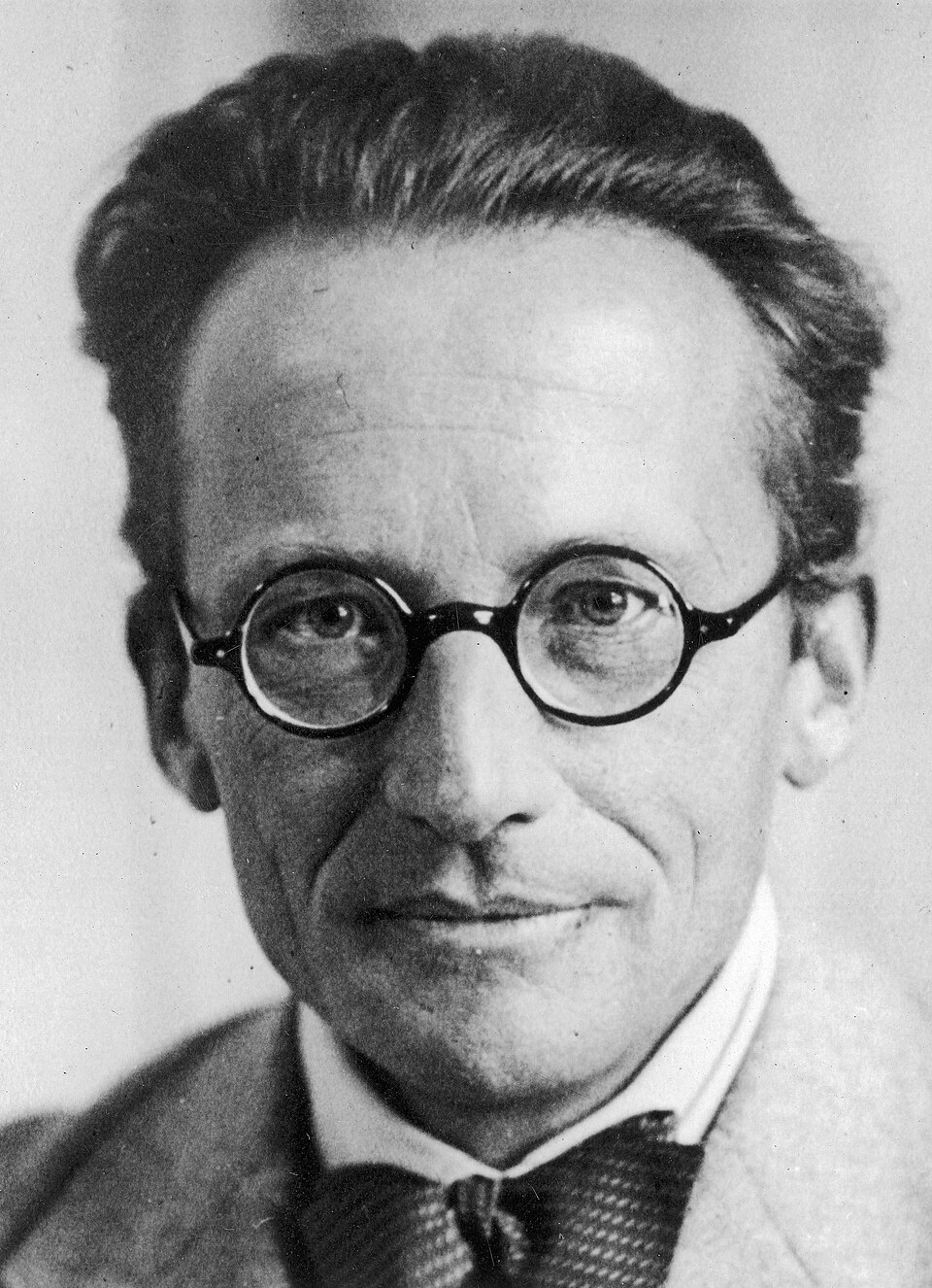
Planck is not being idealistic when he points out the importance of intuition. He knows the risk of a purely intuitive approach. In saying “as soon as we come to look for a rational theory or a logical demonstration, direct intuition is a very doubtful ally,” he highlights that, just as deductive reasoning is ineffectual without inductive leaps, induction is untethered if it is not moored to deduction. Schrödinger uses the word “metaphysics” in place of intuition, but he expresses the same opinion as Planck does about the complementary relationship between logic and intuition:
“I will freely admit at the outset that, from now on, not only am I not going to refrain from metaphysics, nor even from mysticism, but that they play an essential part in all that follows… We have already conceded that we are here dealing not with something logically deducible but with mystical metaphysics… Speaking as a scientist, it seems to me that it is our uncommonly difficult task, as post-Kantians, on the one hand step by step to erect barriers which will restrain the influence of metaphysics on the presentation of facts seen as true within our individual fields — while on the other hand preserving it as the indispensable basis of our knowledge, both general and particular. It is the apparent contradiction in this which is our problem. We might say, to use an image, that as we go forward on the road of knowledge we have got to let ourselves be guided by the invisible hand of metaphysics reaching out to us from the mist, but that we must always be on our guard lest its soft seductive pull should draw us from the road into an abyss. Or, to look at it another way: among the advancing hosts of the forces of knowledge, metaphysics is the vanguard, establishing the forward outposts in an unknown hostile territory; we cannot do without such outposts, but we all know that they are exposed to the most extreme danger. Or again: metaphysics does not form part of the house of knowledge but is the scaffolding, without which further construction is impossible. Perhaps we may even be permitted to say: metaphysics turns into physics in the course of its development — but not of course in the sense in which it might have seemed to do so before Kant. Never, that is, by a gradual establishing of initially uncertain opinions, but always through a clarification of, and change in, the philosophical point of view.”
Erwin Schrödinger, My View of the World (1961)
Planck recognizes that in some circumstances intuition is a “doubtful ally.” Schrödinger demonstrates the same awareness when he writes “we must always be on our guard lest its soft seductive pull should draw us from the road into an abyss.” Nevertheless, both realize that it has an indispensable role in fundamental research. Planck frames it as a “provisional bridge” opening the way for “heavy artillery of critical logic.” In his own military analogy Schrödinger says intuition is a “vanguard, establishing the forward outposts in an unknown hostile territory” that, while necessary, are “exposed to the most extreme danger.”
We will explore this danger more in a moment, but for now let’s turn to Bohm to summarize the nature of healthy dynamic interplay between intuition and deduction. Like Schrödinger and Planck, Bohm recognizes that both intuition and logic are needed in physics research:
“Clearly it is necessary that thought should have the possibility of standing firm, if it is to function properly. But this ‘firm standing’ must find its appropriate place in the broader context of the flowing movement of intuitive reason. It is only in this broader context that thought can become the vehicle of creative perception. Indeed, when there is free play of the mind, thought has its ultimate origin in such perception. It then unfolds in a natural way, through proposition, composition, supposition, and disposition. It is transformed into something fairly well defined and, as it were, crystallized. Such crystallization of reason, which is ruled by formal logic, is indeed absolutely indispensable if the proposals in which thought begins are to be tested properly for their rationality and for their coherence with the actual fact. Nevertheless, formal logic has to be ready to dissolve back into flowing reason, whenever a sustained contradiction or opposition develops in the application of its relatively fixed forms… One form is to see truth as absolutely identified with formal logic. But another is, similarly, to identify truth with intuition and to fail to be open to the need for rigorous tests of this intuition, under appropriate circumstances, with the aid of formal logic. Moreover, rigidly fixed opinions, which are actually based on the misuse of formal logic, often present themselves in a somewhat vague and undefined guise that pretends to be genuine intuitive perception.”
David Bohm & F. David Peat, Science, Order, and Creativity (Routledge, 1987), pp. 146–147
In other words, operating purely intuitively, without maintaining a fidelity to experimental precision and logical consistency, leads one into a world of illusions and fantasy. On the other hand, operating purely “logically,” ignoring the feelings that direct one’s attention to the logical contradictions in one’s current model, is its own kind of falsehood. We can only deepen our understanding of reality by being totally committed to logical consistency while simultaneously remaining open to new ideas and feelings.
At a meta level, we can recognize Peter Higgs’s words at the beginning of this section as reflecting an ossification of our view of the creative process itself. In the following excerpt from Planck’s earlier quote he is talking about the rigidity of certain scientific theories, and this extends to our “theory of the creative process”:
“We must further recognize that the authors of a new and practicable theory are frequently little inclined to introduce any important changes in the groups of ideas which led them towards their discoveries, whether from indolence or from a certain sentimental feeling, and that they often exert the whole of their well-earned authority in order to be able to maintain their original standpoint. Thus we shall readily understand the difficulties which often stand in the way of healthy theoretical development.”
Max Planck, The Universe in Light of Modern Physics, p. 36
While the deductive method has met with some success, its overwhelming dominance is currently limiting “healthy theoretical development.” This situation is not unprecedented; quite the contrary, it seems to be part of a deterministic, chaotic resonance in which history repeats through cycles of ossification followed by dramatic revolution, which then ossifies, ad infinitum. For example, Einstein describes a similar situation to our current phase of physics in the period before he began his revolutionary work:
“Now to the field of physics as it presented itself at the time. In spite of all the fruitfulness in particulars, dogmatic rigidity prevailed in matters of principles.”
Albert Einstein, “Autobiographical Notes,” in Albert Einstein: Philosopher-Scientist, ed. Paul Arthur Schilpp, vol. 1 (Harper & Brothers, 1959), pp. 16–18
Planck’s comment that scientists “often exert the whole of their well-earned authority in order to be able to maintain their original standpoint” applies to the deductive philosophy, which is presently a mono-culture in physics. The belief that a purely deductive method is sufficient to bring about progress in theoretical physics is largely implicit and subconscious and hence goes unexamined. Physicists are not gods but human beings, subject to social and emotional influences on their beliefs as any other person is. Further, it may be that physicists tend to be particularly curious. This instinct to unify apparently disparate phenomena into a single coherent picture (in Einstein’s words, “unification of the manifold”) may even make us more susceptible to falling prey to illusions. Einstein summarizes this reality succinctly:
“It is in this striving after the rational unification of the manifold that it encounters its greatest successes, even though it is precisely this attempt which causes it to run the greatest risk of falling prey to illusions.”
Albert Einstein, Science and Religion (1940)
Intuition in physics is not vague and amorphous, as is commonly thought. At its best it is objective and consistent because it is intuition about real physical systems which must operate according to some kind of logic and consistency. Part of the antidote to this illusion is a conversation about the value of intuitive approaches to solving problems in theoretical physics. That was the topic of this section. The following section is an extension of this one. In it we will look at how the intuitive approach to physics works with special emphasis on the value of using physical pictures as the basis of our creative process.
Part 4 · Section 1.3
Physical Pictures
“They were of the same large type as Thornton, living close to the earth, thinking simply and seeing clearly”
Jack London, The Call of the Wild
“As a mathematical discipline travels far from its empirical source, or still more, if it is a second and third generation only indirectly inspired by ideas coming from ‘reality’ it is beset with very grave dangers. It becomes more and more purely aestheticizing, more and more purely l’art pour l’art… there is a grave danger that the subject will develop along the line of least resistance, that the stream, so far from its source, will separate into a multitude of insignificant branches, and that the discipline will become a disorganized mass of details and complexities… whenever this stage is reached, the only remedy seems to me to be the rejuvenating return to the source: the re-injection of more or less directly empirical ideas. I am convinced that this was a necessary condition to conserve the freshness and the vitality of the subject and that this will remain equally true in the future.”
John von Neumann, “The Mathematician,” in The Works of the Mind, ed. Robert B. Heywood, vol. 1, no. 1 (Chicago: University of Chicago Press, 1947), pp. 180–196
von Neumann’s words are perhaps more relevant today than they have ever been. We heard in the introduction to part 1 that when physicists ask about the physical meaning of the collapse of the wave function they are often told that such questions are “philosophical” and not something a physicist should think about. This current situation with the supposed collapse of the wave function in quantum mechanics is the type of crisis von Neumann warned us about. We will talk about the physical meaning of wave mechanics in part 3, but this section of our report is dedicated to illustrating the value of physical pictures in general. With that context established, let’s turn to David Bohm to frame our discussion:
“This attitude towards the mathematics has not always been dominant in physics. Indeed until the present century, the physical concepts were, for the most part, considered as primary, while mathematical equations were regarded as providing a more detailed and precise way of talking about these physical concepts. However, during the twentieth century with the advent of quantum theory (and to a lesser extent, relativity) the mathematics became much more highly developed and the physical interpretation much more abstract and indirect, as well as much less clear. As a result there was a constantly increasing focus on the mathematics, while the physical ideas were given less and less importance. Thus during the 1920s Sir James Jeans said that God must be a mathematician, implying by this that the universe was constructed on a mathematical plan and that its essence is best grasped in terms of the mathematics itself. Later, Heisenberg went much further along these lines and said very explicitly that the essential truth was in the mathematics. This view has become the common one among most of the modern theoretical physicists who now regard the equations as providing their most immediate contact with nature (the experiments only confirming or refuting the correctness of this contact). So without an equation there is really nothing to talk about. On the other hand, in the past we began talking about our concept of physical reality and used the equations to talk about them.
One of the reasons that our interpretation of the quantum theory may not have been so well understood is perhaps that it is not commonly realised that we have a rather different attitude to the mathematics. Our approach is not simply a return to the notion that the mathematics merely enables us to talk about the physical concepts more precisely. Rather we feel that these two kinds of concepts represent extremes and that it is necessary to be in a process of thinking that moves between these extremes in such a way that they complement each other.
We fully accept that progress can be made from the mathematical side alone, but we feel that to stick indefinitely to this approach is too limited… as we shall see in this chapter, we can then move to the other side of this process of thought and take our physical concepts as a guide for the development of new equations. In this way we are engaged in at least the beginning of a kind of thinking in which the clue for a creative new approach may come from either side and may flow indefinitely back and forth between the two sides.”
David Bohm & B. J. Hiley, The Undivided Universe, pp. 320–321
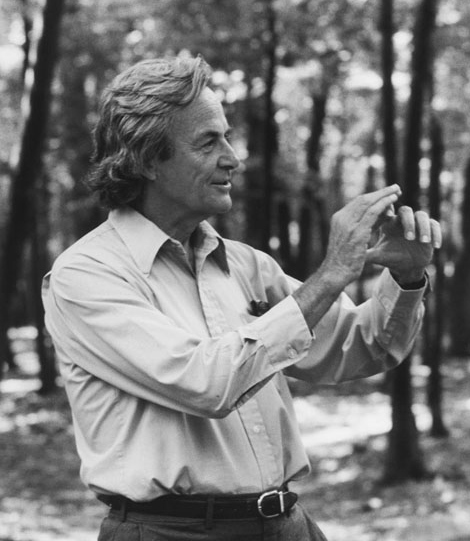
In agreement with our discussion in the previous section, David Bohm emphasizes the complementary relationship between intuitive physical pictures and deductive rigor. Rather than talk abstractly about this relationship (as we did already), let’s listen to some specific examples from Richard Feynman in which we will see that Feynman used physical reasoning as his foundation, with mathematical concepts supplementing his understanding as a kind of scaffolding:
“At all these places everybody working in physics would tell me what they were doing and I’d discuss it with them. They would tell me the general problem they were working on, and would begin to write a bunch of equations. ‘Wait a minute,’ I would say. ‘Is there a particular example of this general problem?’ ‘Why yes; of course.’ ‘Good. Give me one example.’ That was for me: I can’t understand anything in general unless I’m carrying along in my mind a specific example and watching it go. Some people think in the beginning that I’m kind of slow and I don’t understand the problem, because I ask a lot of these ‘dumb’ questions: ‘Is a cathode plus or minus? Is an an-ion this way, or that way?’ But later, when the guy’s in the middle of a bunch of equations, he’ll say something and I’ll say, ‘Wait a minute! There’s an error! That can’t be right!’ The guy looks at his equations, and sure enough, after a while, he finds the mistake and wonders, ‘How the hell did this guy, who hardly understood at the beginning, find that mistake in the mess of all these equations?’ He thinks I’m following the steps mathematically, but that’s not what I’m doing. I have the specific, physical example of what he’s trying to analyze, and I know from instinct and experience the properties of the thing. So when the equation says it should behave so-and-so, and I know that’s the wrong way around, I jump up and say, ‘Wait! There’s a mistake!’ So in Japan I couldn’t understand or discuss anybody’s work unless they could give me a physical example, and most of them couldn’t find one. Of those who could, it was often a weak example, one which could be solved by a much simpler method of analysis. Since I was perpetually asking not for mathematical equations, but for physical circumstances of what they were trying to work out.”
Richard P. Feynman (1985), “Surely You’re Joking, Mr. Feynman!”: Adventures of a Curious Character, W. W. Norton & Company, p. 224
Given the context of our previous discussion, and Feynman’s clear style of communication, I do not believe I need to explain further what is meant by him here. In economy of thought let us then turn immediately to another quote from Feynman, in which he gives a specific example (liquid helium) of his non-mathematical theoretical physics work:
“I cannot explain what goes on in my mind clearly because I am actively confusing it and I cannot introspect and know what’s happening. But visualization in some form or other is a vital part of my thinking and it isn’t necessary I make a diagram like that. The diagram is really, in a certain sense, the picture that comes from trying to clarify visualization, which is a half-assed kind of vague, mixed with symbols. It is very difficult to explain, because it is not clear. My atom, for example, when I think of an electron spin in an atom, I see an atom and I see a vector and a psi written somewhere, sort of, or mixed with it somehow, and an amplitude all mixed up with xs. It is impossible to differentiate the symbols from the thing; but it is very visual. It is hard to believe it, but I see these things not as mathematical expressions but a mixture of a mathematical expression wrapped into and around, in a vague way, around the object. So I see all the time visual things associated with what I am trying to do. It was always with visualization. There was a lot of visualization and a lot of analysis. Analysis is much more powerful when you can do it, especially when you want to publish something or explain something; or when you want to be sure that what you have thought is clear and correct. Then the analysis, the mathematics is wonderful. That’s why it looks like, when I write it, trying to do mathematics. What I really am trying to do is to bring birth and clarity, which is really a half-assedly thought out pictorial semi-vision thing. OK? I would see this jiggle-jiggle-jiggle, or the wiggle of the path or the influence of the other thing. Even when I talk now about the influence functional: I see the coupling and I try, I take this turn — like as if there is a big bag of stuff and try to collect it away and to push it. It’s all visual… I see the character of the answer before me — that’s what the picturing is. Ordinarily I try to get the pictures clearer but in the end, the mathematics can take over and can be more efficient in communicating the idea than the picture. In certain particular problems that I have done it was necessary to continue the development of the picture as the method before the mathematics could really be found.
One delightful example that I really got big pleasure out of, is the liquid helium problem that I like because I spent a long time picturing that damn thing and doing everything without writing any equations and it was one time in my life where I did an awful lot of physics with my hands tied behind my back because I didn’t know how to write a damn thing and there was nothing I could do but keep on picturing… and I couldn’t get anything down mathematically… So the whole thing was worked out first, in fact, was published first as a descriptive thing… which doesn’t carry much weight, but to me was the real answer. I really understood it and I was trying to explain it. It is a very difficult tool to explain pictures, and our methods of communications are nowhere near as good. But I really, honestly believed that paper with the description… would really be a very clear description [of] how it works,… and that anyone reading it could also visualize it without writing anything. Fortunately, in that case I then got the picture clear enough, I suggested the type of wave function,… it came out numerically and could show I am on the right track by having the analysis. But I knew I had the right answer in the visual thing.”
S. S. Schweber (1994), QED and the Men Who Made It: Dyson, Feynman, Schwinger, and Tomonaga, Princeton University Press, p. 466
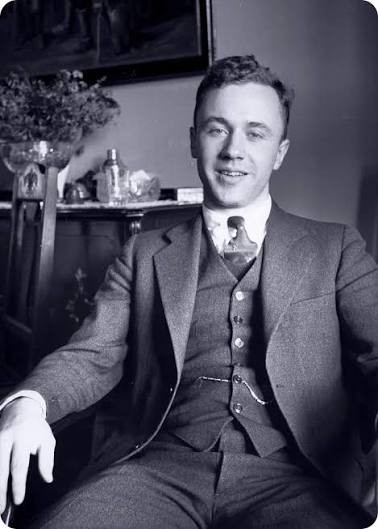
Feynman’s thesis advisor John Wheeler also preferred thinking in physical (geometrical) pictures to working things out purely deductively (algebraically):
“Wheeler had helped develop Feynman’s ‘geometrical’ way of thinking. When Wheeler explains things, he always makes use of pictures and diagrams. Wheeler says of himself: ‘I think geometrically rather than in words. I think in terms of pictures.’”
S. S. Schweber (1994), QED and the Men Who Made It: Dyson, Feynman, Schwinger, and Tomonaga, Princeton University Press, p. 369
This “thinking in terms of pictures” is the intuitive form of reasoning we discussed earlier that is presently undervalued in physics. As a physics student once remarked, “there are no pictures in the quantum mechanics textbook.” (The specific book was Introduction to Quantum Mechanics, third edition, by David J. Griffiths.) This lack of visual pictures of physical processes extends to most of the textbooks used in the physics curriculum. It is inexplicable through logical means why time and funds have not been invested in creating visual examples of physical phenomena and incorporating these examples into the standard undergraduate and graduate physics courses. The technology exists to create such visualizations, and the financial return of investing in this kind of pedagogy would be hundreds to one in long-term economic productivity from the resulting innovations of physicists. For an example of the kind of visuals I mean, an excellent visual presentation of the electromagnetic field can be seen in the YouTube video “How wiggling charges give rise to light” hosted by the channel 3Blue1Brown. Another great video is “Potential landscape view of the 2D quantum hydrogen atom with large angular momentum” hosted by the channel Nils Berglund. The video description explains that “The video shows a simulation of the quantum hydrogen atom, in which the z-coordinate shows the sum of the Coulomb potential and the modulus squared of the wave function, thereby providing a better idea of what it means that the electron ‘falls into the potential well created by the proton.’” This second video gives a good feeling for what is meant by the phrase “an electron is a wave.”
Part 5 · Section 1.3 (Continued)
Authority, Complementarity & Visualization
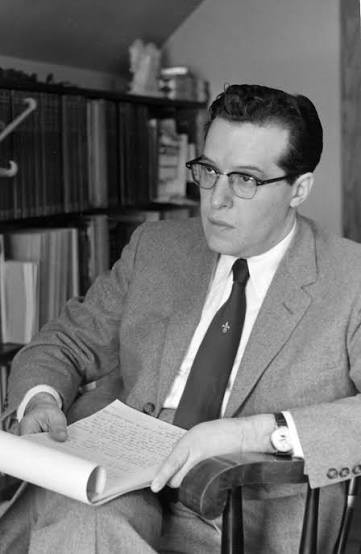
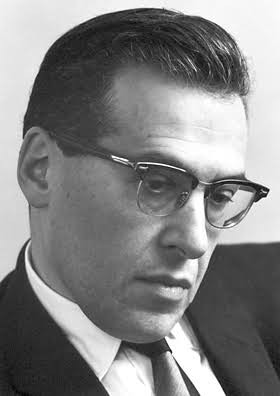
The fact that this physical reality is not emphasized to physics students can be explained by looking at the history of physics and Niels Bohr’s powerful influence on the way we view quantum mechanics. Niels Bohr put forward his complementarity principle, which plays a fundamental role in the Copenhagen interpretation of quantum mechanics. Its impact on the physics community is expressed by Julian Schwinger in the following quote:
“Schwinger went on to talk about Bohr’s complementarity principle — ‘perhaps the widest philosophical principle that has emerged from the studies of microscopic systems.’”
S. S. Schweber (1994), QED and the Men Who Made It: Dyson, Feynman, Schwinger, and Tomonaga, Princeton University Press, p. 361
Note that “microscopic systems” means quantum mechanics in this context. The complementarity principle is the statement that “there is a classical world, there is a quantum world, and we can never understand both as part of a unified physical picture.” In other words, we can use classical particle-based pictures, or we can visualize the quantum wave, but if we want to ask about the relationship between those two pictures we are told that such a question is illegitimate. We will discuss this more in part 3, but for now the point is that this view of the world as fundamentally divided into two different realities was not conducive to believing it was even possible to construct a coherent, unified physical picture of reality. This is probably the primary reason “there are no pictures in the quantum mechanics textbook.”
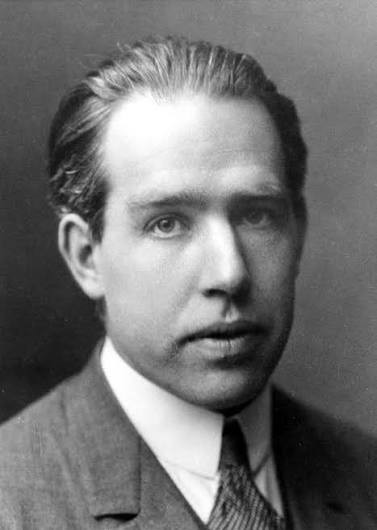
Niels Bohr explains his beliefs about the limitations of visualization implied by quantum mechanics:
“A similar remark applies to the collision between two material particles, although the significance of the quantum postulate for this phenomenon was disregarded before the necessity of the wave concept was realised. Here this postulate does indeed represent the idea of the individuality of the particles which, transcending the space-time description, meets the claim of causality… It is scarcely necessary to mention that for a more detailed description of the interaction between individuals we cannot restrict ourselves to the facts expressed by formulae (1) and (2), but must resort to a procedure which allows us to take into account the coupling of the individuals, characterising the interaction in question, where just the importance of the electric charge appears. As we shall see, such a procedure necessitates a further departure from visualisation in the usual sense… Already the formulation of the relativity argument implies essentially the union of the spacetime co-ordination and the demand of causality characterising the classical theories. In the adaptation of the relativity requirement to the quantum postulate we must therefore be prepared to meet with a renunciation as to visualisation in the ordinary sense going still further than in the formulation of the quantum laws considered here.”
Niels Bohr, “The Quantum Postulate and the Recent Development of Atomic Theory,” Nature 121, no. 3050 (April 14, 1928): 580–590
Of course you already know I disagree with Bohr on this point, and in part 3 we will visualize the emergence of the classical world from the quantum picture, but for the moment I would like to take a historical detour to illustrate how it is the case that Niels Bohr may be in large part responsible for the fact that “there are no pictures in the quantum textbook.” I should add as a qualifier here that there are other forces limiting visualization in physics which we will explore in part two. Nevertheless, especially with regards to quantum mechanics (our most fundamental theory), Bohr has objectively had a massive influence on how we think about it. We have already seen that Bohr emphasized the limits of visualization, so now I would like to demonstrate that he had the power and influence to make his views mainstream.
In 1921 Bohr founded the Niels Bohr Institute as an official department within the University of Copenhagen, and this institute became the uncontested gravitational center of theoretical physics in its day. Partly this was due to Bohr’s political acumen and natural ability for acquiring funding, which quickly led to his institute becoming the global mecca for theoretical physics. A large amount of funding was supplied by the American Rockefeller Foundation, whom Bohr successfully lobbied for massive grants, making his institute one of the most well-funded theoretical physics centers in the world.
This gave Niels Bohr immense political power, surpassing Albert Einstein in absolute power and scientific authority among 20th-century physicists, outranking every other physicist in his ability to steer the direction of modern physics. While Einstein was the world’s most famous individual genius, Bohr wielded unmatched institutional, political, and philosophical power over the entire physics community.
For instance, we can see an example of Bohr’s clout in the way the “big shot” scientists working on the Manhattan Project were “afraid of him”:
“Feynman comments: ‘I was always dumb about one thing. I never knew who I was talking to. I was always worried about the physics. If the idea looked lousy, I said it looked lousy. If it looked good, I said it looked good… I have always lived that way.’ Feynman’s discussion with Bohr went on for quite a while, and when it was finished Bohr said, ‘I guess we can call in the big shots now.’ At that point Bohr assembled the leading members of the theoretical division and had a discussion with them. Aage Bohr later explained to Feynman what had transpired. After his first conference his father had told him that Feynman had been the only person at the meeting who was not afraid of him and who had been willing to say that an idea of his was ‘crazy.’ ‘So,’ said Bohr, ‘next time when we want to discuss ideas, we are not going to do it with these [big shots]… who say everything is yes, yes Dr. Bohr. Get [Feynman] and we’ll talk with him first.’”
S. S. Schweber (1994), QED and the Men Who Made It: Dyson, Feynman, Schwinger, and Tomonaga, Princeton University Press, pp. 402–403
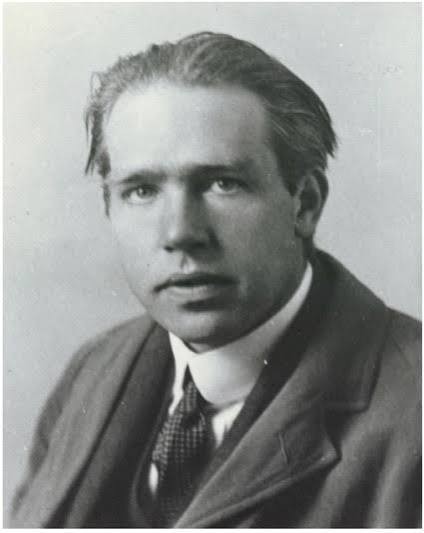
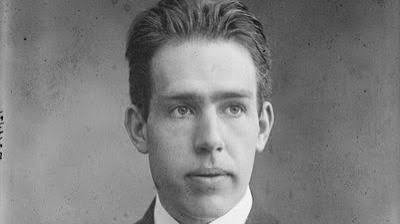
We see further evidence of Niels Bohr’s charisma and influence in the fact that after he won his 1922 Nobel Prize, the Carlsberg brewery corporation gave him a private villa in Copenhagen built by Carlsberg founder J. C. Jacobsen in 1854. During his 30-year residency from 1932 to 1962, the villa became famous as the informal global headquarters of quantum physics and a critical crossroads for international diplomacy. Giants of science like Albert Einstein, Werner Heisenberg, Wolfgang Pauli, and Max Planck were frequent guests. Bohr as well hosted royalty, prime ministers, and foreign ambassadors at the dinner table. Notably, Queen Elizabeth II and Sir Winston Churchill were among the prominent dignitaries entertained at the villa.
The following excerpt from the Niels Bohr Institute’s website gives some feeling of how much influence Bohr had in shaping physics culture:
“The European Physical Society has declared the Niels Bohr Institute as a Historical Site with great international importance for developments in physics and research. The Niels Bohr Institute has been selected on this basis: ‘This is where the foundation of atomic physics and modern physics were created in a creative scientific environment inspired by Niels Bohr in the 1920s and 30s… Niels Bohr created a fundamental change in thinking in physics and at the same time he managed to create an international environment that attracted some of the best scientists from around the world. The many foreign researchers visited Copenhagen, where they exchanged views and ideas with each other and with Niels Bohr. Several of them were later awarded the Nobel Prize for their work.’”
Niels Bohr Institute (2013)
If you were a young aspiring scientist, or even a high-ranking senior scientist, challenging Niels Bohr directly on a subject as important to him as the meaning of quantum mechanics (and the possibility of visualizing the physical relationship between the classical and quantum worlds) was probably not a very wise career decision. More importantly, not only did Niels Bohr have the power to diminish the standing of others, he also held the carrot. His institute was the hub of modern theoretical physics, so if you were an enterprising scientist, rational action would incentivize you not to disagree with Bohr on the possibility of visualizing quantum processes. This influence is inevitably passed down through generations as each new generation of scientists is trained to adopt the tenets of the previous one. And so today we do not teach our students to visualize the wave function.
Of course not all scientists were cowed by fear of Bohr’s authority. We saw Feynman courageously choose to invest his attention in pursuit of physical truths rather than in trying to impress Bohr. Perhaps it is not surprising that in the following quote Feynman explicitly rejects Bohr’s anti-visualization philosophy:
“I dislike all this talk of others [of there] not being a picture possible, but we only need know how to go about calculating any phenomenon. True we only need calculate. But a picture is certainly a convenience & one is not doing anything wrong in making one up. It may prove to be entirely haywire while the equations are nearly right — yet for a while it helps. The power of mathematics is terrifying — and too many physicists finding they have correct equations without understanding them have been so terrified they give up trying to understand them. I want to go back & try to understand them.
What do I mean by understanding? Nothing deep or accurate just to be able to see some of the qualitative consequences of the equations by some method other than solving them in detail.
For example I’m beginning to get a mild ‘understanding’ of the place of Dirac’s α matrices which were invented by him ‘to produce an equation of first order in the differential coefficient in the time,’ but by me in order ‘to keep track of the result of a succession of changes of coordinate system…’
Why should the fundamental laws of Nature be so that one cannot explain them to a high-school student — but only to a quite advanced graduate student in physics? And we claim they are simple! In what sense are they simple? Because we can write them in one line. But it takes 8 years of college education to understand the symbols. Is there any simple ideas in the laws?”
Richard P. Feynman, quoted in S. S. Schweber (1994), QED and the Men Who Made It: Dyson, Feynman, Schwinger, and Tomonaga, Princeton University Press, p. 408
We see here that the previous quotes in which Feynman expresses his love for physical pictures are not aberrations, but the core of his research style. In the next section we will explore Einstein’s way of thinking as a window into the creative process itself. In that context we will see that what Feynman means by “ideas” in the statement “Is there any simple ideas in the laws” is what he said earlier: “What do I mean by understanding? Nothing deep or accurate just to be able to see some of the qualitative consequences of the equations by some method other than solving them in detail.” In other words, for Feynman the physical picture is the fundamental concept. We will see that this also holds true for Einstein.
Part 6 · Section 1.4
Einstein as a Case Study in Intuition
“Einstein has a feeling for the central order of things. He can detect it in the simplicity of natural laws. We may take it that he felt this simplicity very strongly and directly during his discovery of the theory of relativity.”
Wolfgang Pauli, Statements after the Solvay Conference of 1927, as quoted in Physics and Beyond (1971) by Werner Heisenberg
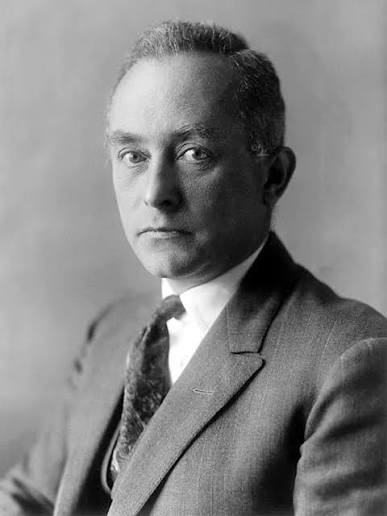
Max Born speaks to Einstein’s intuition by noting his ability to transcend pre-existing categories. This is synonymous with de Broglie’s definition of inductive thinking:
“‘In my opinion he would be one of the greatest theoretical physicists of all times even if he had not written a single line on relativity’ — an assumption for which I have to apologize, as it is rather absurd. For Einstein’s conception of the physical world cannot be divided into watertight compartments.”
Max Born, Physics in My Generation, p. 53
This aspect of Einstein’s mind makes it clear why he rejected Bohr’s “watertight compartments” of fundamentally separate classical and quantum worlds. Bohm identifies the same capacity in Newton that Born recognized in Einstein:
“To begin such an inquiry into creativity, consider the example of Newton’s theory of universal gravitation. Newton’s revolutionary step went far beyond the mere reordering of existing concepts, for it involved a radically new mental perception of nature. The idea that objects may attract each other did not actually originate with Newton. But his genius lay in realizing the full, explicit implications of what was already known within the scientific community.
To break away from the habitual and commonly accepted modes of thought, which had been taken for granted for generations, required intense courage, energy, and passion. Newton had these in abundance, and at the height of his powers, he was always asking fundamental questions. The crucial factor in Newton’s vision, and indeed in the creation of all new ideas, is this ability to break out of old patterns of thought. Indeed, once this has been done, new perceptions and novel ideas appear to arise naturally.”
David Bohm & F. David Peat, Science, Order, and Creativity (Routledge, 1987), pp. 31–32
Just as Bohm noticed with Newton, Max Born identifies Einstein’s philosophical boldness as the singular quality which distinguishes his work in physics:
“But for me — and many others — the exciting feature of this paper was not so much its simplicity and completeness, but the audacity of challenging Isaac Newton’s established philosophy, the traditional concepts of space and time. That distinguishes Einstein’s work from his predecessors and gives us the right to speak of Einstein’s theory of relativity, in spite of Whittaker’s different opinion.”
Max Born, Physics in My Generation, pp. 103, 105
What we see here is that it is not working within established categories (i.e., working deductively) that leads to the big revolutions, but, by definition, it is the work that reshapes the categories and relationships between categories that results in a big leap forward. This is explained by John Holland et al. in their book on inductive reasoning:
“Rather than simply applying operators to a fixed problem representation, the representation itself may be transformed by recategorizing problem components and by retrieving associations and analogies. Such restructuring implies that search takes place not only in the space of potential ‘next states’ along a temporal dimension but also through a space of alternative categorizations of the entities involved in the problem. This type of processing depends on the parallel activity of multiple pieces of knowledge that both compete with and complement each other in revising the problem representation. Such interactive parallelism is a hallmark of the theoretical framework for induction we will present… although schemas are valuable for chunking information together, they exact a toll in inflexibility.”
John H. Holland et al., Induction: Processes of Inference, Learning, and Discovery (MIT Press, 1986), pp. 11–12
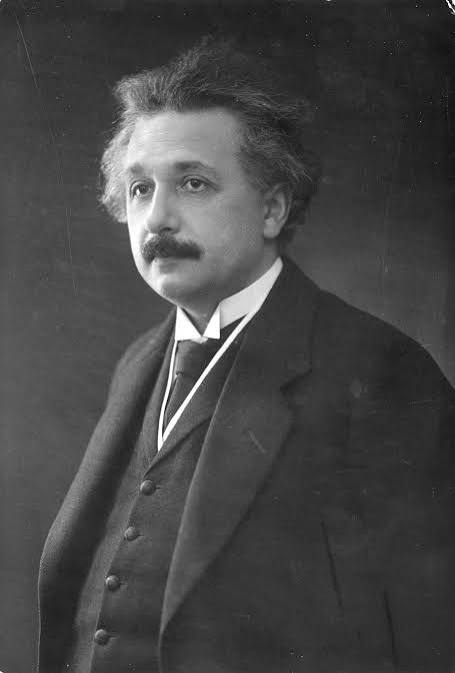
Einstein was self-aware of his internal creative experience (this is not surprising given his innate ability to understand physical processes at a pre-logical level) and his reflections give us a valuable data point on the process of transcending pre-established categories of thought:
“I believe in intuition and inspiration… At times I feel certain I am right while not knowing the reason. When the eclipse of 1919 confirmed my intuition, I was not in the least surprised. In fact I would have been astonished had it turned out otherwise. Imagination is more important than knowledge. For knowledge is limited, whereas imagination embraces the entire world, stimulating progress, giving birth to evolution. It is, strictly speaking, a real factor in scientific research.”
Albert Einstein, Cosmic Religion: With Other Opinions and Aphorisms (1931), p. 97
We see that for Einstein, intuition was the foundation of creativity. His emphasis that imagination is the generative source of new ideas in physics, whereas preexisting knowledge structures are limited, is aligned with our discussion of deduction and induction in subsection 1.2. Let’s hear more from Einstein:
“Fundamental ideas play the most essential role in forming a physical theory. Books on physics are full of complicated mathematical formulae. But thought and ideas, not formulae, are the beginning of every physical theory. The ideas must later take the mathematical form of a quantitative theory, to make possible the comparison with experiment.”
Albert Einstein & Leopold Infeld, The Evolution of Physics (1938)
Recall Feynman saying, “Is there any simple ideas in the laws?” Here we develop our feeling of what he meant, because Einstein is expressing the same emotion when he says “Fundamental ideas play the most essential role in forming a physical theory.” These “ideas” are simply physical pictures that we believe in, not as abstractions but as intuitively felt and understood realities. It is these intuitively grasped feelings that Einstein is referring to when he says “thought and ideas, not formulae, are the beginning of every physical theory.” This actually makes a lot of sense. The brain evolved to model and predict the environment. It’s going to devote more cognitive resources to understanding things that it believes actually exist, because it is just those things which are relevant to survival. In other words, mathematical formulas are not going to have the same level of salience as a physical picture, and nor should they, as the formula is a more abstract and hence a less real construction from the perspective of the enterprising mind. That is to say, a mathematical concept is more isolated from the constellation of other mathematical concepts than a physical concept is from its neighbors. I can much more easily understand the connection between classical and quantum mechanics (which is not to say I understand it totally) than I can understand the relationship between set theory and topology. The former being actual physical realities in the external world and the latter existing as a physical reality as a pattern of neurons in the mathematician’s head, which is not a very easy pattern for me to decode.
I can’t believe in anything unless I can see it working in reality. You can talk to me about topology and set theory and what have you and I am happy to listen. I find the ideas very interesting. But unless you can point and say “and here’s what it looks like in the machinery in the universe,” my default feeling is not to believe in it. It’s like heaven and hell to me. For instance, I believe in fractals because we see fractal structures in nature. For example, fractals are present in quantum mechanics and we will use Feynman’s path integral to explore them in part 4. In the meantime, let’s return to Holland, who explains that thought lies deeper than language:
“Another criticism that has been directed at standard production systems is that they treat intelligence primarily in terms of quasi-linguistic representations and inference processes akin to those associated with conscious thinking (for example, Newell and Simon 1972; Anderson 1983). Hofstadter (1985, chap. 26) has distinguished between ‘cognitive’ and ‘subcognitive’ approaches to the understanding of intelligence. Subcognitive approaches assume highly parallel processing of small units of information, taking place below the level of conscious awareness. Many theorists have argued that a great deal of mental processing, underlying activities ranging from early visual pattern recognition to more abstract categorization and hypothesis-generation tasks, takes place at the subcognitive level. Standard production systems, because of their seriality and their use of abstract linguistic categories in the conditions of rules, do not appear to offer a description of subcognitive processing. Needed instead are more flexible systems in which categories can emerge through inductive mechanisms without being built in by the programmer.”
John H. Holland et al., Induction: Processes of Inference, Learning, and Discovery (MIT Press, 1986), p. 25
Einstein describes his internal process of visualization. This is the same process of “subcognitive understanding” discussed by Holland above:
“The words of the language, as they are written or spoken, do not seem to play any role in my mechanism of thought. The psychical entities which seem to serve as elements in thoughts are certain signs and more or less clear images which can be ‘voluntarily’ reproduced and combined. There is, of course, a certain connection between those elements and relevant logical concepts. It is also clear that the desire to arrive finally at logically connected concepts is the emotional basis of this rather vague play with the above-mentioned elements… The above-mentioned elements are, in my case, of visual and some muscular type. Conventional words or other signs have to be sought for laboriously only in a secondary stage, when the mentioned associative play is sufficiently established and can be reproduced at will.”
Albert Einstein, Answer to a survey written by the French mathematician Jacques Hadamard, from Hadamard’s An Essay on the Psychology of Invention in the Mathematical Field (1945)
Einstein’s experience shows us that mathematical equations were not the foundation of his creative process. And yet it is just these tools that are placed at the center of modern physics education. It is not that mathematics is useless — Einstein’s own work has plenty of equations — rather it is that mathematics’ role has been misunderstood. It is a language. We can no more expect to develop a revolutionary physical concept through purely mathematical means than we can expect to do so only by inventing new words. The culture of modern physics is not wrong for seeing mathematical methods as valuable tools, but it makes a mistake when it attempts to use them in place of physical concepts.
Part 7 · Section 1.5
Analogies
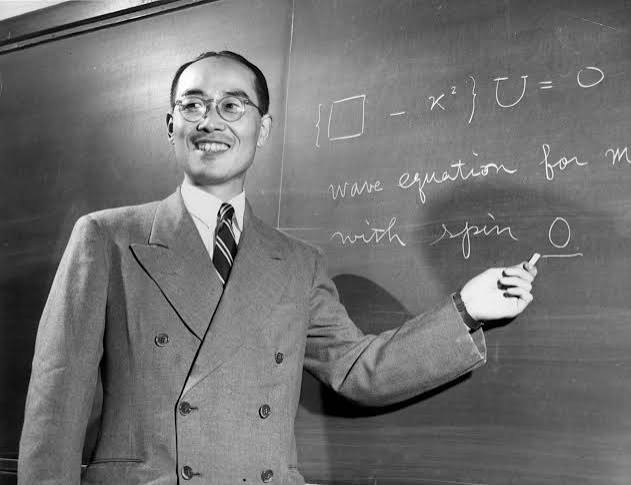
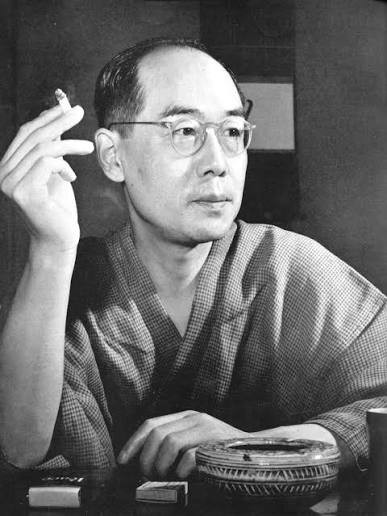
Categories themselves, such as “wave” or “particle,” are analogies. A water wave is not the same as a wave in the air or a wave through a solid material. No two things in existence are exactly the same, otherwise we would not say they are two different things. And yet things do have common properties that allow us to group them in useful and intuitive ways. Waves of all kinds have much in common, hence the existence of the category “wave.” This is very obvious; I’m not telling you something you don’t already know. But it is one of those things that’s so obvious we don’t pay enough attention to it. Yukawa explains:
“One further point I would like to make concerns the ways in which the intuition and imagination undergo self-development. There are various possibilities here, but one of the most outstanding importance is analogy. Analogy is the most concrete of the ways of applying relationships formed within a certain sphere to another and different sphere… The essence of analogy as a form of creative thinking can be briefly put. Suppose that there is something which a person cannot understand. He happens to notice the similarity of this something to some other thing which he understands quite well. By comparing them he may come to understand the thing which he could not understand up to that moment. If his understanding turns out to be appropriate and nobody else has ever come to such an understanding, he can claim that his thinking was really creative…
Thus Newton succeeded in finding out the universal laws of motion together with the universal laws of gravitation. In short, he did not identify one thing with another, but identified the relation between things in one case with the relation between things in another case. As I mentioned earlier, Newton seems to have been concerned also with the identity of things, which led him to believe in atomism. Perhaps, though, he thought it was premature to deal with atoms systematically. Now, we physicists know that the laws of motion of invisibly small atoms or electrons turned out to be quite different from the laws of motion of visible things which had been discovered by Newton. We know now the identity of the fundamental constituents of matter and energy. Any two electrons, for instance, are identical to each other, there being no mark whatsoever to discriminate one from the other. If we further ask why they are completely the same, the answer may be that they are created according to the same laws of nature. In this sense, the laws of nature play the role of molds for creating various kinds of particle which are identical to any other particle of the same kind, because they are the products of the same mold.
In contrast to the case of Newton, there is no longer a clear distinction between the identification of laws of motion of different things and the identification of the fundamental constituents of matter and energy. The process of identification must evolve to the stage in which the unified description of elementary particles of all kinds is achieved in the sense that both the reason for their existence and the reason for their specific behavior are explained by the same fundamental laws. This is the great expectation of physics. To realize this expectation, the creative thinking of physicists is needed today as much as in the past… There can be no theory of creativity, I feel, that does not take analogy — which is itself one of the functions of the human intelligence — as its starting point. It is here, and nowhere else, that we must look for the essence of creativity.”
Hideki Yukawa (1973), Creativity and Intuition: A Physicist Looks at East and West (J. Bester, Trans.), Kodansha International, pp. 58, 59, 114, 122, 138